The State Emblem of Pakistan was adopted in 1954. The emblem's green colour and the star and crescent at the top are symbols of Islam, the religion with which most Pakistani citizens identify. In the center is a quartered shield, with each quarter containing a major crop of Pakistan at the time of its adoption: cotton, jute, tea, and wheat. The floral wreath around the shield is Poet's Jasmine (the national flower) and represents the Mughal cultural heritage of Pakistan. The scroll at the bottom contains the national motto in Urdu, coined by Muhammad Ali Jinnah, which reads from right to left: (Urdu: ایمان ، اتحاد ، نظم) Iman, Ittehad, Tanzeem translated as "Faith, Unity, Discipline".
Monday, December 6, 2010
Saturday, December 4, 2010
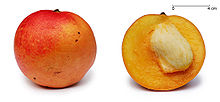
NATIONAL FRUIT OF PAKISTAN
Mangifera indica is a species of mango in the Anacardiaceae family. It is found in the wild in India and cultivated varieties have been introduced to other warm regions of the world.
The species appears to have been domesticated about 4,000 years ago.[citation needed] The species was brought to East Asia around 400-500 BCE from India; next, in the 15th century to the Philippines; and then, in the 16th century to Africa and Brazil by the Portuguese.[1] The species was described for science by Linnaeus in 1753.[2]
Mango is the national fruit of both India and Pakistan. It finds mention in the songs of 4th century CE Sanskrit poet, Kalidasa, prior to it is believed to have been tasted by Alexander (3rd century BCE) and Chinese pilgrim, Hieun Tsang (7th century CE). Later in 16th century Mughal Emperor, Akbar planted 100,000 mango trees in Darbhanga, Bihar at a place now known as Lakhi Bagh
National Fruit
Mangoes belong to the genus Mangifera, consisting of numerous species of tropical fruiting trees in the flowering plant family Anacardiaceae. The mango is indigenous to the Indian Subcontinent.[3] Cultivated in many tropical regions and distributed widely in the world, mango is one of the most extensively exploited fruits for food, juice, flavor, fragrance and color, making it a common ingredient in new functional foods often called superfruits. Its leaves are ritually used as floral decorations at weddings and religious ceremonies.
Thursday, December 2, 2010
NATIONAL FLAG OF PAKISTAN
The national flag was designed by Syed Ameer uddin kidwai[15] and was based on the original flag of the Muslim League. It was adopted by the Constituent Assembly[16] on August 11, 1947, just days before independence.[17][18][19] The flag is referred to in the national anthem as Parcham-e-Sitāra-o-Hilāl in Urdu (lit. Flag of the Crescent and Star). The flag comprises a dark green field, representing the Muslim majority of Pakistan, with a vertical white stripe in the hoist, representing religious minorities.[15] In the centre is a white crescent moon, representing progress, and a white five-pointed star, representing light and knowledge.[15] The flag symbolizes Pakistan's commitment to Islam, the Islamic world and the rights of religious minorities.[20] The flag is flown on several important days of the year including Republic Day and Independence Day.[21] The flag is also flown on the residences and motor vehicles of many public officials including the President and the Prime Minister.
What Does The National Flag Of Pakistan Represent?
The national flag of the Islamic Republic of Pakistan is green and white in color. Being the first country, which had emerged on the face of the world map providing a homeland for the Muslims of the subcontinent where they would have no qualms about the deserving prospect of practicing their religion, Pakistan's flag, which would be a symbolic representative of the country, was to contain the true essence of its spirit and succinctly yet meticulously elucidate the profound purpose, due to which Pakistan ultimately came into being.
Paying close attention to all these factors, the flag of Pakistan was finally delineated. The green segment of the flag represents the majority of Pakistan's population, who were Muslims. As for the white part, which has a smaller area on the flag, this reasonably and collectively symbolizes the minorities who are living in Pakistan. The moon is a meaningful emblem of Islam and stands for the assurance of religious harmony and freedom. Whereas the star with five corners signifies each of the five provinces that were part of Pakistan back in 1947. Today East Pakistan isn't part of Pakistan anymore and has instead been made into Bangladesh, which was the fifth province of Pakistan.
NATIONAL BIRD OF PAKISTAN
Chukar
The Chukar (Alectoris chukar) is a Eurasian upland game bird in the pheasant family Phasianidae of the order Galliformes, gallinaceous birds. Its native range in Asia from Pakistan and Kashmir, India and Afghanistan. It is closely related and similar to its western equivalent, the Red-legged Partridge, Alectoris rufa. The Chukar is a rotund 32-35 cm long bird, with a light brown back, grey breast, and buff belly. The face is white with a black gorget. It has rufous-streaked flanks and red legs. When disturbed, it prefers to run rather than fly, but if necessary it flies a short distance on rounded wings. Chukar prefer rocky, steep, and open hillsides. The Chukar is a resident breeder in dry, open, and often hilly country. In the wild, Chukar travel in groups of 5-40 birds called coveys. It nests in a scantily lined ground scrape laying 8 to 20 eggs. Chukars will take a wide variety of seeds and some insects as food. When in captivity, they will lay 1 egg per day throughout the breeding season if the eggs are collected daily. For hunters, Chakur is a very challneging bird becuase of its surgical upward flights and sudden disappearances in the bushes.
Description
The Chukar is a rotund 32–35 cm (13–14 in) long partridge, with a light brown back, grey breast, and buff belly. The shades vary across the various populations. The face is white with a black gorget. It has rufous-streaked flanks, red legs and coral red bill. Sexes are similar, the female slightly smaller in size and lacking the spur.[2] The tail has 14 feathers, the third primary is the longest while the first is level with the fifth and sixth primaries.[3]
It is very similar to the Rock Partridge (Alectoris graeca) with which it has been lumped in the past[4] but is browner on the back and has a yellowish tinge to the foreneck. The sharply defined gorget distinguishes this species from the Red-legged Partridge which has the black collar breaking into dark streaks near the breast. Their song is a noisy chuck-chuck-chukar-chukar from which the name is derived.[5] The Barbary partridge (Alectoris barbara) has the a reddish brown rather than black collar with the grey throat and face with a chestnut crown.[6]
Other common names of this bird include Chukker (sometimes spelled as 'Chuker' or 'Chukor'), Indian Chukar and Keklik.
Wednesday, December 1, 2010
National Animal of Pakistan
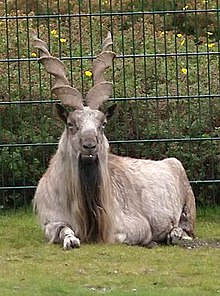
The Markhor (Capra Falconeri Falconeri) mainly inhabits the sparsely wooded mountainous regions in Northern and Western Pakistan, at an elevation of 600-3,600 m / 1,900-11,500 ft. The total world population is mainly found in Pakistan. Today, Markhor are present in around 20 of Pakistan's protected areas. In the northern mountainous regions is found the Kashmir and Astor Markhor. The Kashmir Markhor (C. f. cashmirensis ) is mainly confined to Chitral Gol National Park and presents the biggest population in Pakistan.
SOME FACTS ABOUT MARKHOR
Markhor
The Markhor (Capra falconeri) is a large species of wild goat that is found in northeastern Afghanistan, Pakistan in (Gilgit-Baltistan, Hunza-Nagar Valley, northern and central Pakistan, and Kashmir), southern Tajikistan and southern Uzbekistan. The species is classed by the IUCN as Endangered, as there are less than 2,500 mature individuals which continued to decline by an estimated 20% over 2 generations.[1] The Markhor is the National Animal of Pakistan.SOME FACTS ABOUT MARKHOR
You really can’t miss the Markhor since they are one unique looking goat. Besides the long furry coat the Markhor also has unusual horns. The spiraled horns of the male can grow as long as 1.5 m (4.9′). Meanwhile the horns of the female are not nearly as impressive as they typically grow to about 50 cm (1.9′). Personally, I would have been impressed with the 2 foot horns on the female if it weren’t for the 5 foot long male horns.
Typically these goats can be found on the mountains ranging anywhere from 600 -3600 m above sea level. In case anyone is unsure just how high that is I will try to clear it up for you. That is really really high! For my non-metric friends to the south, it is just under 12 000 feet. So what the heck to these animals eat all the way up there? Well, like most goats they graze on grasses and shrubs. They just happen to be a very important part of the ecosystem since they are constantly transferring the seeds around the mountain. You would think that a life on the edges of cliffs would be pretty safe. Unfortunately this is not the case as the Markhor still have several predators including wolves, lynx and snowy leopards. Is nowhere safe anymore?
NATIONAL SPORT OF PAKISTAN
Hockey
Field Hockey is the national Sport in Pakistan, but today, Cricket is the most popular Sport in Pakistan.[1] Traditional Sports like Kabaddi and other well known games are also played. The Pakistan Sports Board was created in 1962 by the Ministry of Education as a corporate body for the purposes of promoting and developing uniform standards of competition in Sports in Pakistan comparable to the standards prevailing internationally, and regulating and controlling Sports in Pakistan on a national basis. The Ministry of Culture, Sports and Tourism, now has control over the Pakistan Sports Board. The PSB controls all 39 Sporting Federations. The Pakistan Sports Board is support by the Pakistan Sports Trust which assists hard up players and associations so they can continue participating in sports.
Over recent years there has been an increase in sporting activity in Pakistan, with Pakistani sportsmen and women participating at many national and international events. Also, more international tournaments now take place in Pakistan. The size of the teams Pakistan sends, and the number of events they participate in the Olympic Games, Asian Games, World Games and Commonwealth Games has increased since the turn of the century.
History of Pakistan Hockey in Olympics
Pakistan Hockey Federation was established in 1948, to guide and look after the players. The Pakistan Hockey team was also given a name-Green Shirts. Since then, Hockey has become Pakistan's national game. Pakistan has a glorious history in Men's Hockey. The past is glorious. The nation has won 3 gold medals in field hockey in summer Olympics. The journey actually started with 1956 Olympics, when the Pakistani national side reached Olympics final for the first time. The nation got independence in 1947, so this was a big achievement. India defeated Pakistan in this final, but the green shirts never lost hope. They level the defeat of 1956 final with an impressive victory in Olympics of 1960.
In the next 4 Olympics, Pakistan never left the field without going to the victory stand. Pakistan proved it that their winning the Olympics in 1960 was no fluke. Pakistan played the final match in 1964, 1968 and 1972 for 3 consecutive Olympics, winning the gold medal in 1968 and silver medal in the other two Olympics.
Pakistani Green shirts were not able to reach the final of the Olympics in 1976 and 1980, but they did strike back full force in 1984 and snatched the gold medal from the strongest opponent West Germany. After 1984, Pakistan has reached the victory stand in Olympics hockey only once. That was back in 1992, for a bronze medal.
In fact Pakistan's first international win was over Belgium on the 2nd of August, 1948, at the fourteenth Olympic Games. Since then, their game has been progressing from strength to strength. And world-class players like-Hassan Sardar, Mohammed Saqlain, Shahbaz Ahmed, Mansoor Ahmed, Sohail Abbas, Kaleemullah Khan, Waseem Ahmad, Shahnaz Sheikh, Samiullah Khan and Manzoor Hussain, among others-will forever find their names etched in letters of gold!
The Pakistan Hockey teams are best remembered for their performances at the various Olympiads. Every Summer Olympics is after all an international event, and it requires a lot of grit and excellence to overcome competition from so many participating countries! And this Pakistan managed to do wonderfully, especially on the "hockey" field! The winning squads were carefully chosen to represent the country, and they did not fail the faith placed in them! Their record has really been enviable! They are the proud owners of three gold medals at the Summer Olympics held in 1960, 1968, and 1984. The 1960 Olympics was special to Pakistan as Pakistan won the gold medal in Olympics for the first time.
Also, Pakistan defeated the arch rival India in the final. In the 1968 Olympics final, Pakistan defeated Australia to snatch the crown. Pakistan beat West Germany in 1984 to win the gold medal third time. Since then Pakistan has not performed in the usual brilliant way in any Olympics. And so what if they did not receive gold medals during the other Olympiads? They did manage to bag 3 silvers and 2 bronze in their place! The nation is proud of its hockey history, and wishes to get back to the crown once again very soon.
Tuesday, November 30, 2010
FOUNDER OF PAKISTAN
Mohammad Ali Jinnah (Urdu: محمد علی جناح, Sindhi: محمد علي جيڻا, Gujarati: મુહમ્મદ અલી જિન્ના,
Audio (help·info)); December 25, 1876 – September 11, 1948) was a 20th century lawyer, politician, statesman and the founder of Pakistan. He is popularly and officially known in Pakistan as Quaid-e-Azam (Urdu: قائد اعظم — "Great Leader") and Baba-e-Qaum (باباۓ قوم) ("Father of the Nation").
Jinnah served as leader of the All-India Muslim League from 1913 until Pakistan's independence on August 14, 1947 and Pakistan's first Governor-General from August 15, 1947 until his death on September 11, 1948. Jinnah rose to prominence in the Indian National Congress initially expounding ideas of Hindu-Muslim unity and helping shape the 1916 Lucknow Pact between the Muslim League and the Indian National Congress; he also became a key leader in the All India Home Rule League. He proposed a fourteen-point constitutional reform plan to safeguard the political rights of Muslims in a self-governing India.
Jinnah later advocated the Two-Nation Theory embracing the goal of creating a separate Muslim state as per the Lahore Resolution.[7] The League won most reserved Muslim seats in the elections of 1946. After the British and Congress backed out of the Cabinet Mission Plan Jinnah called for a Direct Action Day to achieve the formation of Pakistan. The direct action[8][9] by the Muslim League and its Volunteer Corps, resulted in massive rioting in Calcutta[9][10] between Muslims and Hindus.[10][11] As the Indian National Congress and Muslim League failed to reach a power sharing formula for united India, it prompted both the parties and the British to agree to independence of Pakistan and India. As the first Governor-General of Pakistan, Jinnah led efforts to lay the foundations of the new state of Pakistan, frame national policies and rehabilitate millions of Muslim refugees who had migrated from India.
He died in September 1948, just over a year after Pakistan gained independence from the British Empire.
Early life
Jinnah was the first child born to Mithibai and Jinnahbhai Poonja. His father, Jinnahbhai (1857–1901), was a prosperous Gujarati merchant who had moved to Sindh from Kathiawar, Gujarat before Jinnah's birth.[13][16] His grandfather, Poonja Gokuldas Meghji,[17] was a Hindu Bhatia Rajput from Paneli village in Gondal state in Kathiawar. Jinnah's ancestors were Hindu Rajputs who had converted to Islam.[16] Jinnah's family belonged to the Ismaili Khoja branch of Shi'a Islam,[1] though Jinnah later converted to Twelver Khoja Shia Islam.[2][5][6]
The first-born Jinnah was soon joined by six siblings, brothers Ahmad Ali, Bunde Ali, and Rahmat Ali, and sisters Maryam, Fatima and Shireen. Their mother language was Gujarati; in time they also came to speak Kutchi, Sindhi and English.[18] The proper Muslim names of Mr. Jinnah and his siblings, unlike those of his father and grandfather, are the consequence of the family's immigration to the Muslim state of Sindh.
Jinnah was a restless student, he studied at several schools: at the Sindh-Madrasa-tul-Islam in Karachi; briefly at the Gokal Das Tej Primary School in Bombay; and finally at the Christian Missionary Society High School in Karachi,[12] where, at age sixteen, he passed the matriculation examination of the University of Bombay.[19]
Years in England
In 1892, Jinnah was offered an apprenticeship at the London office of Graham's Shipping and Trading Company, a business that had extensive dealings with Jinnahbhai Poonja's firm in Karachi.[12] Before he left for England, at his mother's urging, he married his distant cousin – Emibai Jinnah, who was two years his junior;[12] she died a few months later. During his sojourn in England, his mother too would pass away.[16] In London, Jinnah soon left the apprenticeship to study law instead, by joining Lincoln's Inn. It is said that the sole reason of Jinnah's joining Lincoln's Inn is that the welcome board of the Lincoln's Inn had the names of the world's all-time top-ten magistrates, and that this list was led by the name of Muhammad. No such board exists, although there is a mural which includes a picture of Muhammad.[16] In three years, at age 19, he became the youngest Indian to be called to the bar in England.[16]During his student years in England, Jinnah came under the spell of 19th-century British liberalism, like many other future Indian independence leaders. This education included exposure to the idea of the democratic nation and progressive politics. He admired William Gladstone and John Morley, British Liberal statesmen. An admirer of the Indian political leaders Dadabhai Naoroji and Sir Pherozeshah Mehta,[20] he worked with other Indian students on the former's successful campaign to become the first Indian to hold a seat in the British Parliament.
By now, Jinnah had developed largely constitutionalist views on Indian self-government, and he condemned both the arrogance of British officials in India and the discrimination practiced by them against Indians. This idea of a nation legitimized by democratic principles and cultural commonalities was antithetical to the genuine diversity that had generally characterized the subcontinent. As an Indian intellectual and political authority, Jinnah would find his commitment to the Western ideal of the nation-state developed during his English education– and the reality of heterogeneous Indian society to be difficult to reconcile during his later political career.
Western influences on personal life
The Western world not only inspired Jinnah in his political life. England had greatly influenced his personal preferences, particularly when it came to dress. Jinnah donned Western style clothing and he pursued the fashion with fervor. It is said he owned over 200 hand-tailored suits which he wore with heavily starched shirts with detachable collars. It is also alleged that he never wore the same silk tie twice.[21]Return to India
During the final period of his stay in England, Jinnah came under considerable pressure to return home when his father's business was ruined. In 1896 he returned to India and settled in Bombay. Jinnah built a house in Malabar Hill, later known as Jinnah House. He became a successful lawyer, gaining particular fame for his skilled handling of the "Caucus Case".[20] His reputation as a skilled lawyer prompted Indian leader Bal Gangadhar Tilak to hire him as defence counsel for his sedition trial in 1908. Jinnah argued that it was not sedition for an Indian to demand freedom and self-government in his own country, but Tilak received a rigorous term of imprisonment.[20]When he returned to India his faith in liberalism and progressive politics was confirmed through his close association with three Indian National Congress stalwarts Gopal Krishna Gokhale, Pherozeshah Mehta and Surendranath Banerjee. These people had an influence in his early life in England and they would influence his later involvement in Indian politics.[22]
Early political career
In 1896, Jinnah joined the Indian National Congress, which was the largest Indian political organization. Like most of the Congress at the time, Jinnah did not favour outright independence, considering British influences on education, law, culture and industry as beneficial to India. Jinnah became a member on the sixty-member Imperial Legislative Council. The council had no real power or authority, and included a large number of un-elected pro-Raj loyalists and Europeans. Nevertheless, Jinnah was instrumental in the passing of the Child Marriages Restraint Act, the legitimization of the Muslim waqf (religious endowments) and was appointed to the Sandhurst committee, which helped establish the Indian Military Academy at Dehra Dun.[13][23] During World War I, Jinnah joined other Indian moderates in supporting the British war effort, hoping that Indians would be rewarded with political freedoms.Jinnah had initially avoided joining the All India Muslim League, founded in 1906, regarding it as too Muslim oriented. However he decided to provide leadership to the Muslim minority. Eventually, he joined the league in 1913 and became the president at the 1916 session in Lucknow. Jinnah was the architect of the 1916 Lucknow Pact between the Congress and the League, bringing them together on most issues regarding self-government and presenting a united front to the British. Jinnah also played an important role in the founding of the All India Home Rule League in 1916. Along with political leaders Annie Besant and Tilak, Jinnah demanded "home rule" for India—the status of a self-governing dominion in the Empire similar to Canada, New Zealand and Australia. He headed the League's Bombay Presidency chapter.
In 1918, Jinnah married his second wife Rattanbai Petit ("Ruttie"), twenty-four years his junior. She was the fashionable young daughter of his personal friend Sir Dinshaw Petit, of an elite Parsi family of Bombay. Unexpectedly there was great opposition to the marriage from Rattanbai's family and Parsi society, as well as orthodox Muslim leaders. Rattanbai defied her family and nominally converted to Islam, adopting (though never using) the name Maryam Jinnah, resulting in a permanent estrangement from her family and Parsi society. The couple resided in Bombay, and frequently travelled across India and Europe. In 1919 she bore Jinnah his only child, daughter Dina Jinnah.
In 1924 Jinnah reorganized the Muslim League, of which he had been president since 1919, and devoted the next seven years attempting to bring about unity among the disparate ranks of Muslims and to develop a rational formula to effect a Hindu Muslim settlement, which he considered the pre condition for Indian freedom. He attended several unity conferences, wrote the Delhi Muslim Proposals in 1927, pleaded for the incorporation of the basic Muslim demands in the Nehru report, and formulated the “Fourteen Points”[24]
Founding of Pakistan
A letter by Jinnah to Winston Churchill
Jinnah gave a precise definition of the term 'Pakistan' in 1941 at Lahore in which he stated:
Some confusion prevails in the minds of some individuals in regard to the use of the word 'Pakistan'. This word has become synonymous with the Lahore resolution owing to the fact that it is a convenient and compendious method of describing [it].... For this reason the British and Indian newspapers generally have adopted the word 'Pakistan' to describe the Moslem demand as embodied in the Lahore resolution.[40]Jinnah issued a call for all Muslims to launch "Direct Action" on August 16 to "achieve Pakistan".[41] Strikes and protests were planned, but violence broke out all over India, especially in Calcutta and the district of Noakhali in Bengal, and more than 7,000 people were killed in Bihar. Although viceroy Lord Wavell asserted that there was "no satisfactory evidence to that effect",[42] League politicians were blamed by the Congress and the media for orchestrating the violence.[43] Interim Government portfolios were announced on October 25, 1946.[44] Muslim Leaguers were sworn in on October 26, 1946.[45] The League entered the interim government, but Jinnah refrained from accepting office for himself. This was credited as a major victory for Jinnah, as the League entered government having rejected both plans, and was allowed to appoint an equal number of ministers despite being the minority party. The coalition was unable to work, resulting in a rising feeling within the Congress that independence of Pakistan was the only way of avoiding political chaos and possible civil war. The Congress agreed to the division of Punjab and Bengal along religious lines in late 1946. The new viceroy Lord Mountbatten of Burma and Indian civil servant V. P. Menon proposed a plan that would create a Muslim dominion in West Punjab, East Bengal, Baluchistan and Sindh. After heated and emotional debate, the Congress approved the plan.[46] The North-West Frontier Province voted to join Pakistan in a referendum in July 1947. Jinnah asserted in a speech in Lahore on October 30, 1947 that the League had accepted independence of Pakistan because "the consequences of any other alternative would have been too disastrous to imagine."[47]
The independent state of Pakistan, created on August 14, 1947, represented the outcome of a campaign on the part of the Indian Muslim community for a Muslim homeland which had been triggered by the British decision to consider transferring power to the people of India.[48]
Subscribe to:
Posts (Atom)